
Rib Return to Play Part Five: Try and See (Smartly)
Probe, Sense, Respond

The 85% Trap
At five weeks out, much of my basic capacity started to return. I put more than half of my standard lifts back in while keeping BFR (I have developed a bit of a love affair). Five weeks out from my rib injury and in spite of progress I still was not one hundred percent. Prone pressure and direct contact were still definite no-nos.
That said, I’m at the point where I can do around 85% of the things in the gym I could normally do. Movements like RDLs, heavy dumbbell rows, and turkish get ups are back on the menu along with more dynamic plyometric work. Most things I do in the gym feel good and it feels good to be coming back.
This does not mean I’m ready for sport.
That’s the trap. This is the spot in RTP where athletes and coaches often get it wrong. They either rush or drag the process both resulting in a lack of integrated readiness. It’s so easy too. Athletes start to feel good so they return back into the sport training or competition environment without a real representation of their capacity or performance rehab specialists keep the umbilical cord attached so long the athlete never really tests themselves.
The Problem With Sanitized Progress
Gym metrics are necessary but not sufficient for understanding if the athlete is ready for the full performance environment. The more sanitized environment of the gym is great for tracking progress against movement milestones but it cannot replicate the dynamics of the sport environment where physicality, the shifting environment, and the psychology of the athlete intersect in real time.
Reduction in pain, access to movement, and improved strength and stamina are important but represent flat, even ground. Jiu jitsu is not flat ground. Live and unscripted resistance add chaos, speed, unexpected vectors of movement, and emotional stakes. Passing every gym benchmark is still an untested hypothesis against another human being.
Dave Snowden, whose work I referenced in Part Two, offers another elegant framework for navigating exactly this kind of complexity.
Probe-Sense-Respond
Probe, Sense, Respond is a heuristic borrowed from Snowden’s, Cynefin (Kuh-nev-in) framework. Snowden argues that when we deal with complex systems there are too many parts changing too fast to adhere to rigid protocols. Instead we have to try something (Probe), watch what the system does (Sense), and then do the next best thing we can (Respond).
This is exactly what I needed in order to keep myself from falling into the eighty five percent trap. A way to test my progress in a way that more accurately represented sports demands without jumping headfirst into a setback.
Probe — First, Try Something
I knew I was ready to get back on the mat a few weeks ago, just not full tilt. Direct connections around my torso are still something I’m not ready to allow. I don’t want to find out my cartilage isn’t healed by feeling it pop again.
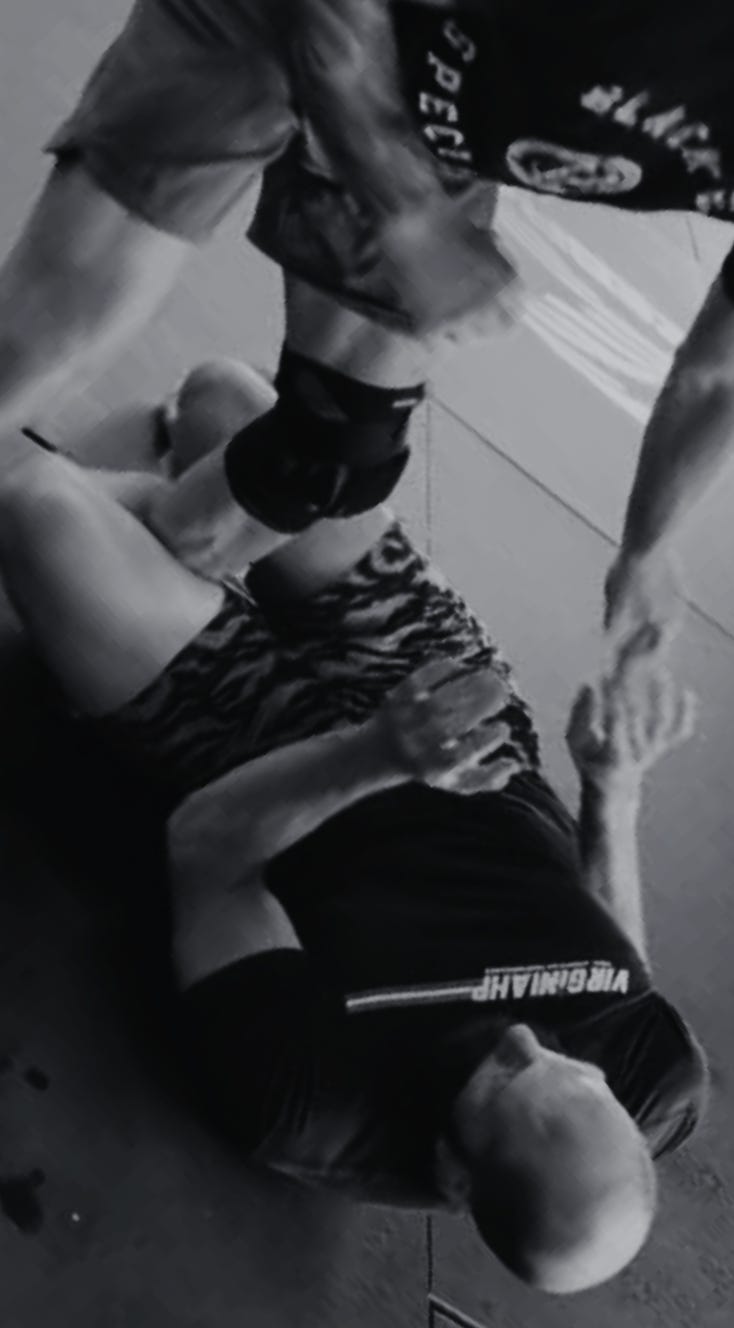
I needed a way to carefully probe my capacity without breaking the bank - luckily I have a trustworthy training partner and an accommodating coach. Gavin Corbe, co-founder of Black Box Grappling Club carved out a broken old man corner. My main training partner, Tyler Minton, is coming back from a recent knee injury as well so it’s a great opportunity for both of us to ease back into training.
We are focusing on a series of progressive small-sided games to improve seated guard and supine guarded positions. We’ve been playing a lot of guard games focused on getting and keeping feet inside while a standing opponent looked to get to and hold the line of the knee.This allows for representative game play while being constrained enough to care for each other’s healing structures. Neither Tyler nor myself are ready for open rolling just yet but these games provide a deliberate way to get information that is more reflective of the full sport.
Sense — What the System Actually Said
Being on the mat with a training partner and a tactical focus made me aware of some things that may have otherwise gone unnoticed.
One thing noticed in particular was clear hesitation to rotate fast or commit forward as the top player. I’m not normally a timid player so this was a defensive mechanism from my nervous system. The delay in action was providing a kind of protective margin in conditions it does not yet trust.
Physical and psychological readiness are entangled but can be nested into separate timelines. This unintentional holding back wasn’t a failure but instead was important information about my place in the grand scheme of things. As I have received more post session information about delayed effects of grappling I’ve gotten more confident in taking chances and allowing contact.
One thing that did surprise me initially was that my abs got sore after the first day of guard training and again a few days later from very low volume hollow rocks. While the soreness was in my abs in general, it was noticeably concentrated in my ghost ab.
While this was a short term hit to my ego because I’ve historically had a very strong trunk, I wasn’t able to do hollow rocks at all until very recently. While there’s still some clear visual atrophy my ghost ab seems to be functionally waking up thanks to a combination of a Marc Pro and some concentrated flexion work.
The direct electrical stimulation woke that bad boy up without any direct mechanical load. Something very useful when nerve supply to the tissue has been disrupted. In addition to that I engineered a fun cable rotational pull down exercise that really emphasizes coordination between my lat, intercostals, obliques, and my little ghost ab (video below). I’m working both sides but as you may have guessed the injured side has to work harder than the other.
The last bit of subjective data came on the mat during game play just this week. During a normal guard game I got focused on the task getting to top half guard (one of the bottom player’s legs is pinned between your knees while they are flat) and the bottom player drove their shin into my ribs while trying to prevent me from consolidating a win. It didn’t hurt. In fact, I didn’t think much of it until after it happened again.
It wasn’t that it was a dramatic or explosive event, I didn’t take a round kick to the ribs or anything, but it did show a tidal shift I wasn’t expecting. That’s how those happen sometimes; there’s not clean before and after but a subtle moment where something that was off limits quietly shifted and with it the tone of the next step in the process.
Respond — Next Best Thing, Not Perfect Plan
Now that I have a more context rich understanding I can respond to my body honestly. I don’t have to have the next stage planned out perfectly but I can more clearly see the next best thing.
I’m free to add more variability and intensity on the mat (smartly) as well as getting back to normal movements and training loads in the gym. This probably won’t be the flick of a switch but will be more like sprinkling in some mini-probes to see how things go. I’ve been hesitant to engage in direct contact but in coming weeks I’ll play with closer connected games while staying careful with partner selection and intensity.
The Probe-Sense-Respond framework makes intuitive sense but there’s a spot where coaches and athletes very often get it wrong. They breeze through the sense part. They try things without enough time or consideration to effects and then jump right into large shifts.
Taking time to “sense” doesn’t mean we have to sit on our hands and delay progress. It does mean we have to deeply consider the multiple layers of effects that are occurring. Being inattentive may cause you to miss important clues that can advance progress in unexpected ways. Once you throw a rock in the pond, wait for some ripples before you throw in another one that obscures your sense of the effect.
Constrained Games as Diagnostic, Not Destination
Using small sided games as a diagnostic tool provides more clarity as we determine appropriate progress in a representative environment. They allow for a more layered and integrative approach to returning to performance. Not just for me and my little rib, but for any athlete looking to get back to their field of play as an integrated whole.
Constrained training is not some lesser version of the sport. The goal of these sessions isn’t to prove overall health and readiness, necessarily. It’s a controlled way to get “thicker” data about how I respond to the performance environment. They have information baked into them that is simply not available in the more sterile strength and conditioning environment.
In the Water Now
I’m not all the way back in the game - yet. Prone contact and violent rotation are still off the menu and my upper ab is still ghosting all my texts. But at least now I’m reading the tide because I’m in the water.
Paddling out is a far cry from watching on the shore.
Thanks for reading,
Rob
[It’s been a few weeks since my last post because some more pressing life stuff got in the way. In the meantime I’ve kept notes on the changes which come in waves and volleys.
If you’re new this week this article is the fifth in a series to document lessons from my return to play from a recent rib separation. I recommend you go back and check out the other articles in this series to get up to speed. It’ll only take a few minutes. ]
Coming Soon:
Part 6 seed — working title something like “What Injury Taught Me to Keep”